why kings cross workers are switching painkillers for assisted stretching
Desk Workers in Kings Cross Are Discovering the One Thing Their Body Actually Needs To Relieve Pain
And it’s not ibuprofen.
If you work near Kings Cross, Coal Drops Yard, inside Kings Place or anywhere in the surrounding area, you probably spend a significant chunk of your day sitting. Maybe it's at a desk in one of the offices around Granary Square, or driving a train for Network Rail, or at a cafe table. However it looks, the result tends to be the same: a body that feels tight, tense and progressively more uncomfortable as the week goes on.
“most people know that sitting is the new smoking without really understanding why, and that vagueness makes it harder to do anything meaningful about it.”
This is a mechanical problem, and like most mechanical problems, it has a solution. But first it helps to understand what is actually happening to your body when you sit for long periods, because most people know that sitting is the new smoking without really understanding why, and that vagueness makes it harder to do anything meaningful about it.
What Sitting Is Actually Doing to Your Body
When you sit down, your hip flexors shorten. Find these at the front of your hips. When you sit, they are held in a shortened position for hours at a time. Do that repeatedly, day after day, and those muscles begin to adapt to that shortened length. They stop being willing to return to their full length, and when you eventually stand up and try to walk or move freely, they pull on your pelvis and your lower spine.
That pulling is what causes the low back ache that so many desk workers treat as simply a fact of life. Your pelvis gets tugged into an anterior tilt, your lumbar curve exaggerates, and the muscles around your lower back work harder than they should just to keep you upright. Over time this creates a pattern of tension and weakness that spreads upward into the thoracic spine, across the shoulders, and right up into the neck.
Meanwhile, your glutes, which should be one of the most powerful and active muscle groups in your body, are spending eight to ten hours a day being sat on. They weaken and stop firing properly and get weak. Because the body is incredibly good at finding workarounds, other muscles try to compensate, often muscles that were never designed to do that job, which is how you end up with tight hamstrings and tight calves that have nothing to do with running, or a hip that aches when you climb stairs, walk for a long time or run. You may even find your knees ache or feel stiff or unstable when you have weak glutes as well.
Your upper body tells a similar story. Leaning towards a screen with one hand on the mouse pad rounds the shoulders forward, lengthens and weakens the muscles between your shoulder blades, and shortens the chest. Take a look now, when you hang your arms down by your sides, do your hands face backwards or do your palms face the sides of your thighs? Backwards indicates a rounded shoulder in the wrong position, putting strain on your neck.
Your head will drift forward as you stare at a screen, and for every centimetre your head moves in front of your shoulders, the effective load on your neck roughly doubles. A head held just five centimetres forward feels like twice its actual weight to the muscles and joints supporting it. That is why so many people find their neck and upper trap tension feels almost permanent, no matter how much they try to roll their shoulders back or sit up straight.
The problem is structural, and the solution needs to match it. It’s not just something you have to accept or medicate, its something you have to correct with movement to really take care of your body.
Why Stretching Alone Usually Doesn't Work
Most people who try to address this do try to stretch it out themselves which is the right instinct but the way most of us were taught to stretch, holding a static position for thirty seconds or pulling our head over to one side and waiting, is not particularly effective for the kind of deep, chronic tension that builds up in a body that has been sitting for hours on end most work days and sometimes it can worsen the pain.
Static stretching does lengthen a muscle to some degree if done correctly but the nervous system is protective which is what it is designed to do. When your nervous system senses that a muscle is being lengthened, especially quickly or forcefully such as you pulling your head to one side to stretch your neck, it triggers what is called the stretch reflex, a contraction response we all have built-in our bodies that was designed to prevent injury and pain in our bodies. Even in a slow, controlled stretch, your nervous system will quietly resist to limit how far the muscle will actually allow itself to go to help protect you from injury, the body is clever like that! You might feel the stretch, but you are not necessarily achieving meaningful, lasting change in the tissue and if you feel pain or strain, you’re probably pushing beyond the stretch reflex causing micro-tears and injury that will make things worse not better.
This is where PNF assisted stretching comes in, and why it is clinically proven to be the most effective stretch method available for anyone who genuinely wants to resolve tension for the long term rather than just temporarily relieve it.
What PNF Assisted Stetching Actually Is, and Why It Works So Well
PNF stands for Proprioceptive Neuromuscular Facilitation. That's a mouthful, but the principle is straightforward. It uses the body's own neurological reflexes to get muscles to release more deeply and more willingly than they would with passive stretching alone.
Here is the basic mechanism: when you take a muscle to the edge of its comfortable range and then contract it against resistance, something called the autogenic inhibition reflex kicks in (your stretch reflex that guards against injury and stops your body stretching too far). After the contraction, the nervous system sends a signal to your brain to say it's safe to release which briefly reduces tension in that muscle, creating a window in which it will allow a deeper stretch than it would have accepted before. Effectively, your brain is getting the message that it is ‘safe’ and OK to release further and the outcome is a much deeper stretch than you could ever achieve on your own.
At Stretch Life we specialise in PNF assisted stretching, it was designed in the 1940’s and 50’s by physiotherapists and we use exactly the same approach on our clients. We assess what is happening in your body on an individual basis as every body responds differently and needs different things from mobility work. We will always work on all the major muscle groups and not just a particular area as even if you feel back or hip pain, the body is a chain and balancing the whole body is important.
Effortless For You
It’s effortless for you, the Therapists will guide your body into increased ranges of motion that you would never be able to achieve on your own. The change in how people feel after a session is noticeable immediately.
Not just a general sense of lightness and flexibility, but a real shift in how the body feels and moves. Hips that felt locked start to feel like they belong to you again. Shoulders drop away from your ears, your neck lengthens and we often see a little ‘Stretch Life shimmy’ when people realise their backs, neck and shoulders have been truly released. You'll walk taller because your posture stops being governed by shortened, tight and tense tissues.
You'll also feel deeply relaxed and often with a boost of energy from having your blood oxygenated and your nervous system calmed completely.
Why This Lasts Longer Than a Massage, Even a Sports Massage
We get asked about this a lot, particularly from people who already have a regular sports or Thai massage and wonder whether assisted stretching is just the same thing in different clothing. It is not, and the distinction matters a lot to your body and how long th effects last, not to mention the pain factor.
Massage, including sports massage, works primarily on soft tissue quality. A good massage therapist can release tension, improve circulation, break down adhesions, and leave you feeling substantially better. For many people, massage is genuinely valuable and we are not here to dismiss it. But massage is largely passive and just works on the muscles, not the nervous system as well. You lie on a table and receive treatment and especially with a sports massage, it can feel painful. That’s never the case with PNF assisted stretching which is always pain-free. In massage, the muscle is manipulated externally, but the nervous system's pattern, the way it holds that muscle, the habitual resting tone it maintains, is not fundamentally retrained.
PNF assisted stretching works at a neurological level. Because the contraction-release cycle involves your active participation, the nervous system learns something. It learns that this range of movement is safe, that the muscle can be longer without causing harm, and it updates its settings accordingly. The change is encoded in a way that a passive treatment cannot achieve, which is why the effects tend to last longer and accumulate over time rather than requiring you to keep returning to the same baseline.
In sports massage you'll often be told it's PNF stretching but it is different to the physio-led clinically proven method we use at Stretch Life. A sports massage will often hurt and feel painful as they push you past your stretch reflex which can in turn cause micro tears which your body then has to contract to repair later, leaving you less flexible in the long term. At Stretch Life, there is no pain and no cracking, pulling or pushing you past your limit, it's controlled, pain free and more importantly effective always.
For desk workers in particular, where the problem is a chronic pattern that has been reinforced over months or years, this matters enormously. You do not just want to feel better for a few days, you want the pattern to change.
What to Expect When You Work With a PNF Qualified Stretch Therapist
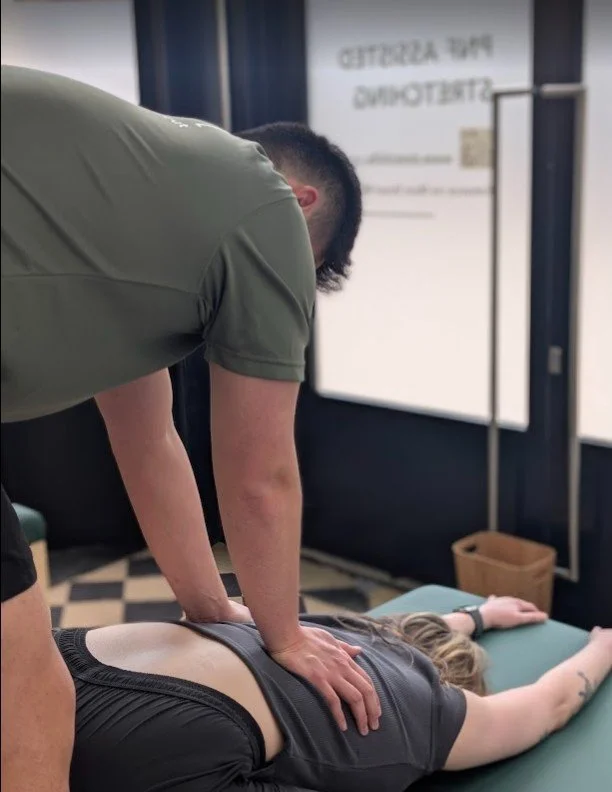
People sometimes come in expecting something similar to a yoga class, a sports massage or a physio appointment, but it's none of those things. You stay fully clothed. There are no needles, no oils, and no prescriptive exercises to do at home, unless you want take home stretches. It is a one-on-one hands-on, personalised stretch session where your stretch therapist does all the work to move your body into deeper ranges of motion.
A session at Stretch Life typically begins with a brief assessment, to look at how you are moving, any imbalances and where things are tight, tense, painful or restricted. From there, your stretch therapist will move your body through a series of assisted PNF stretches targeting the areas that need attention. You will be asked to push against light resistance at certain points, which is the PNF contraction element, and then to relax into the stretch as the therapist guides your limb deeper into the new range.
It is not painful. Most people find the sessions restorative, not unlike the feeling after a very good yoga class or deeply relaxing massage, but more targeted and with results that will both be immediate and lasting.
For desk workers who have been carrying tension in the same places for a long time, the first session is often a revelation in what the body is capable of when the nervous system stops guarding.
How Often Do You Actually Need a PNF Stretch?
This depends on your body and your goals, but for most office workers we see, a 25 min or 50min session once a week or a 50min stretch once a fortnight is enough to make consistent progress. The effects of each session build on the last as the nervous system adapts and the tissues develop more genuine flexibility.
Think of it like dental hygiene, you would not expect to brush your teeth once and have the problem solved forever. Movement health works the same way, the body is constantly adapting to whatever you ask of it, and if you ask it to sit at a desk for forty hours a week, it will adapt to that. Regular assisted stretching is how you counteract that adaptation and keep your body capable of moving the way you want it to.
The good news is that once things start to change, they do not reset to zero between sessions. Progress is real and cumulative.
Why This Matters Specifically If You're in the Kings Cross Area
We are based in and around the Kings Cross and Coal Drops Yard area for a reason. This part of London has become one of the most densely worked postcodes in the city. Between the Google offices, the media companies around Granary Square, the tech firms, the creatives, and the many businesses that have moved into the area over the last decade, there are a lot of people sitting at desks in close proximity to each other, accumulating the same patterns of tension and restriction.
If you have been searching for assisted stretching near me, or looking for flexibility classes in Kings Cross, or wondering whether there is a stretch therapist in the area who actually understands bodies from a physiological perspective rather than a fitness perspective, that is exactly what we do.
Stretch Life is London's only PNF assisted stretching specialist practice, and everything we do is physio-led and backed by clinical evidence. We are not a gym, we are not a spa, we are a movement health practice with a specific and evidence-based approach to helping your body move better, and we are right here in Kings Cross. Find us inside Kings Place on York Way at the junction of Goods Way.
You do not need to be in pain to benefit from this. Plenty of the people we see come in simply because they feel tight and restricted and want to feel freer in their bodies and to calm their nervous system. But if you are in pain, if you have the kind of low back ache or neck tension or tight hips that have become your background noise, then this is for you in a very direct way.
It is not about being flexible in the sense of being able to do the splits. It is about having a body that moves without restriction, that does not hold onto tension by default, and that feels like yours rather than something you are dragging around behind you.
That is what we are here for.
Book your first session at Stretch Life, Kings Cross, Waterloo or Islington now.
www.stretchlife.com
Life’s short - stretch it out