unlocking piriformis syndrome with pnf assisted stretching
Radiating pain from piriformis syndrome? Sciatica? Tight glutes?
If you’ve ever felt a deep, nagging ache in the center of your glutes that radiates down your leg or locks up your lower back, it is a very common issue. In the world of physiotherapy and clinical bodywork, there is one small, stubborn muscle that causes a massive amount of trouble: the piriformis.
“To understand how to resolve your pain, we should look at why the piriformis is so difficult to target on your own, why it causes such widespread pain, and how a specialised technique called Proprioceptive Neuromuscular Facilitation (PNF) can finally make it release and with regular sessions of PNF stretching, the pain is held at bay.”
When this muscle becomes tight or inflamed, it doesn't just cause local discomfort; it can mimic some of the most severe nerve pain managed in clinical practice.
At Stretch Life, we see clients every day who are frustrated because no matter how many Pigeon poses they try or how hard they press a tennis ball into their hips, the tension will not budge and they end up considering surgery to resolve the pain. To understand how to resolve it, we should look at why the piriformis is so difficult to target on your own, why it causes such widespread pain, and how a specialised technique called Proprioceptive Neuromuscular Facilitation (PNF) can finally make it release and with regular sessions of PNF stretching, the pain is held at bay.
What is the Piriformis Muscle, and Why is It Causing You So Much Pain?
The piriformis is a small, flat muscle located deep within the buttocks, starting at the lower spine and connecting to the top of the thigh bone. Its main roles are to rotate your hip outwards and stabilise your pelvis when you walk, run, or stand on one leg.
Because of its specific location, it has an incredibly close relationship with the sciatic nerve. In most people, the sciatic nerve runs directly underneath the piriformis. Anatomical studies show that in up to 30% of the population, the nerve actually passes directly through the muscle fibres.
When the piriformis becomes overworked, tight, or inflamed, it compresses the sciatic nerve. This triggers a condition known as Piriformis Syndrome, which can cause:
A deep, persistent ache in the center of the buttocks
Sharp, shooting pain, tingling, or numbness travelling down the back of the leg (known commonly as sciatica)
Referred pain in the lower back and hips, making it uncomfortable to sit or walk up stairs
Because the body naturally protects itself from pain, a tight piriformis often forces your lower back muscles to compensate, leading to secondary back spasms and chronic posture issues.
The Solo Stretching Dilemma: Why You Can’t Quite Reach Your Full Range Of Motion
Stretching at home only provides relief for a short time, there is a clear anatomical reason for this. Because the piriformis is buried beneath the gluteus maximus (the largest muscle in your body), standard solo stretches rarely isolate it. When you attempt a traditional pigeon stretch on the floor, your larger surface-level glutes absorb the majority of the pull. The piriformis remains shielded underneath, completely untouched.
Trying to aggressively force a deep muscle to stretch on your own often triggers the body's natural stretch reflex. This is a clever protective mechanism controlled by the nervous system; when a muscle is pulled too fast or too hard, the brain sends an immediate signal telling it to contract to prevent a tear or injury. Stretching like this can inadvertently cause the muscle to tighten further.
The PNF Solution: Training the Nervous System to Let Go
To bypass the stretch reflex and reach a muscle as deep as the piriformis, you have to work with the nervous system rather than against it. This is where Proprioceptive Neuromuscular Facilitation (PNF) comes in.
Originally developed by neurophysiologists and physiotherapists over 70 years ago for clinical rehabilitation of neuromuscular conditions and to support elite athlete performance, PNF is a medically proven stretching method that rewires the nervous system to allow your muscles to relax and stretch further without pain.
Here’s what PNF assisted stretching feels like:
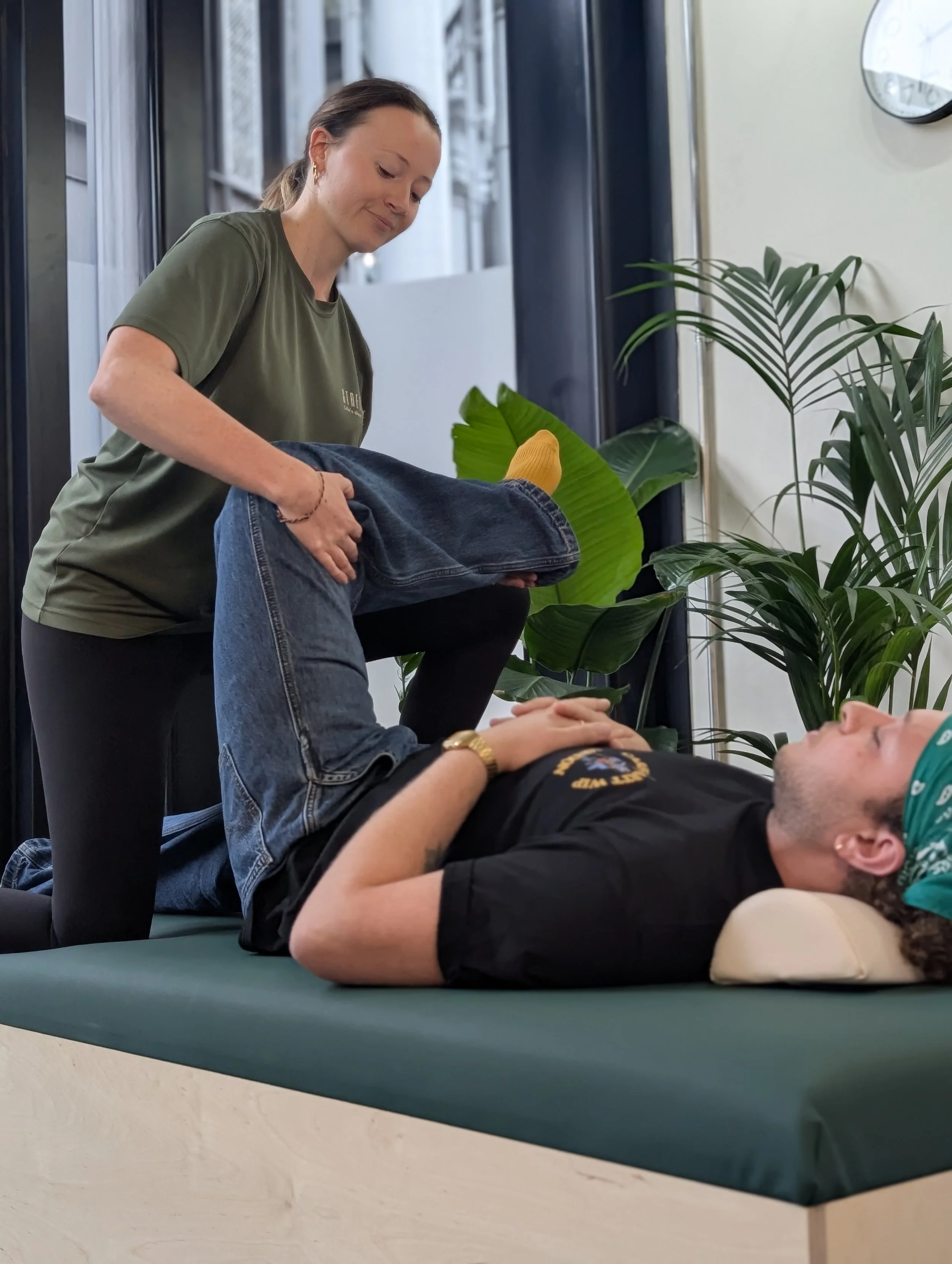
1. The Setup: You lie on one of our bespoke designed beds while your dedicated Stretch Life Therapist moves your limb into a precise angle that gently targets the piriformis.
2. The Contraction: You are asked to push against your Stretch Life Therapist's resistance with about 30%-50% of your strength for a few seconds whilst breathing steadily.
3. The Neuro-Response: When you stop pushing, a neurological phenomenon called autogenic inhibition occurs. For a brief window, the brain temporarily switches off the tension in that specific muscle. It receives a message that it’s safe and pain-free to relax the muscle so that your Therapist can take your body into a deeper range of motion than you could achieve through any other form of stretching. You’ll physically see as well as feel your body and muscles relax and glide into a new range.
4. The Nervous System Rewiring: After your Stretch Life Therapist has safely guided you into a deeper stretch, you’ll be held in this new open position to rewire your nervous system to let your body know that this is the safe, relaxed and pain-free range your muscles are happy to be in so that can hold onto the benefits of the stretch for longer.
5. The Long Term Impact: You’ll feel the results straight away but with regular sessions, you’ll continue to rewire your nervous system to train your body to stay more open for longer, meaning that your pain has a chance to stay away as your muscles are being taught how not to tighten up as opposed to simply being released for a few hours before tightening again which you find with other therapies such as massage, chiropractor, other forms of assisted stretching or sports massage.
Research consistently supports this approach. A comprehensive scientific review published in the Journal of Human titled PNF its mechanisms and effects on range of motion and muscular function, analysed the specific physiological mechanisms of PNF. The study confirms that by utilising reflexes like autogenic inhibition, PNF effectively overrides the nervous system's protective resistance.
This produces significant, immediate improvements in joint range of motion and overall muscle flexibility compared to standard static stretching. It works because it isn’t just pulling on tissue; it is retraining the neuromuscular connection. Think of it as creating a 'muscle memory’ if you like.
Why Choose Stretch Life for Piriformis Relief?
Because the piriformis sits so close to major nerves, getting PNF right requires precise angles, the correct amount of resistance, and a deep understanding of musculoskeletal anatomy. Pushing too hard or in the wrong direction can easily irritate the sciatic nerve further.
At Stretch Life, we are the only dedicated PNF specialists whose staff are trained directly by Musculoskeletal (MSK) Physiotherapists with over 20 years of clinical experience.
We don't believe in a one-size-fits-all approach. Our team understands how to safely isolate the piriformis, decompress the sciatic nerve, and use regular sessions to gradually retrain your nervous system to maintain this new, comfortable length.
If you are tired of managing lower back tightness and deep hip pain on your own, let us do the heavy lifting. We’ll work across the whole kinetic chain in your body for full release with deep targeting of the piriformis and glutes through PNF stretching to give you relief from this chronic condition.
Book a PNF assisted stretch session with one of our Stretch Life Therapists today, and let’s start to get your body moving pain-free.
That is what we are here for.
Book your first session at Stretch Life, Kings Cross, Waterloo or Islington now.
www.stretchlife.com
Life’s short - stretch it out