assisted stretching for hyrox: move better, recover faster, race stronger
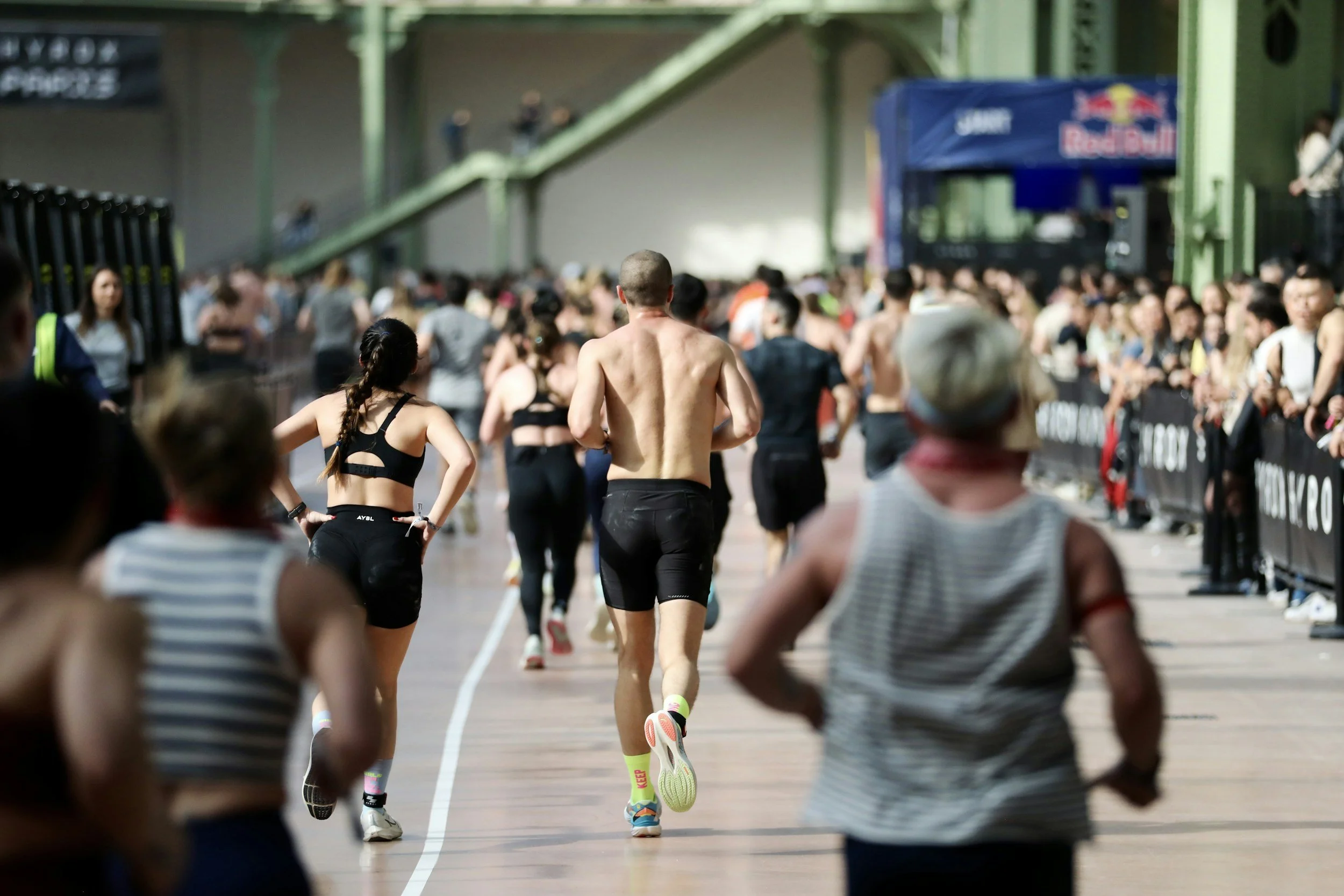
PNF isn’t just stretching, its so much more for your Hyrox-ready body…
“Most sports load one or two movement patterns. Hyrox loads almost all of them, back to back, with running in between. To be the best you can be in the race, you need to work on training your nervous system to work with your muscular system for agility, flexibility and overall fitness performance. That’s where PNF assisted stretching comes into play.”
Hyrox looks straightforward for some. Run 1km, do one hard thing, repeat 8 times. But anyone who has trained for it knows that it asks more of your body than a marathon, a gym session or a CrossFit challenge. You run on legs that have just pushed a sled, you row on a back that has just carried farmers handles, and you finish with 100 wall balls when your hips and shoulders are already tired and under strain.
That is why more Hyrox athletes are adding PNF assisted stretching to their training. Not as a treat, but as part of how they keep moving well through a full training block and arrive at race day with a body that can do what their fitness says it can.
Here is what Hyrox does to your body, what assisted stretching actually is, what the evidence says, and how to use it.
What Hyrox demands from your body
Most sports load one or two movement patterns. Hyrox loads almost all of them, back to back, with running in between. A quick tour of the race:
8 x 1km runs. Repetitive load through the calves, Achilles, hamstrings, hip flexors and glutes, on legs that are getting more tired and less springy with every station.
SkiErg. A powerful pull that relies on the lats, shoulders, triceps and trunk, with a deep hip hinge.
Sled push and sled pull. Quads, glutes, calves and ankles drive the push, while the pull works the back, grip and hips from a low, braced position.
Burpee broad jumps. Full body, repeated, with a lot of demand on the hips, ankles, shoulders and thoracic spine.
Rowing. Needs a long, strong hip and hamstring range at the catch, and a mobile upper back.
Farmers carry. Grip, traps, trunk and the hips, which are asked to stay stable while you walk fast.
Sandbag lunges. Deep, loaded hip flexor and glute work, with the ankles and knees under pressure.
Wall balls. Repeated squats and overhead throws, which need ankle, hip and shoulder range to keep each rep efficient.
Put simply, you use every large muscle group you have, and you use them while fatigued. Any joint or muscle that is stiff or restricted becomes a weak link.
Why tight spots cost you time
When one area lacks range of motion, your body finds the movement somewhere else. Limited ankle mobility in the wall ball squat means the lower back or knees take more load. Tight hip flexors shorten your running stride and push the pelvis forward. A stiff upper back makes the SkiErg and the rowing catch harder than they should be, and the shoulders end up doing the work.
You may not notice this in a fresh session. You will notice it at station six, when form starts to slip and every rep costs more energy than it did in training. Over weeks of training, those small compensations also add up to the niggles that interrupt a block: the tight calf, the cranky hip, the shoulder that will not settle.
What is assisted stretching?
Assisted stretching is one-to-one stretching with a trained therapist, who guides your body into positions and ranges that you cannot reach safely on your own. You cannot fully relax a muscle while you are also the person holding the stretch. A therapist solves that problem.
At Stretch Life, every session uses PNF (proprioceptive neuromuscular facilitation). It is the method behind the results, and it works differently from the static stretching most people know.
In a PNF stretch, your therapist takes the muscle to a comfortable end range, you gently contract against their resistance for a few seconds, then you relax and they move you deeper. That contraction and release is the key. It uses the nervous system's own reflexes to switch down the protective tension that normally stops you going further. You gain range because your nervous system lets go, not because a muscle was forced. That is why it should be pain-free, and why the gains feel so different from simply pulling harder.
Where PNF comes from
PNF is not a recent trend. It was developed in the 1940s and 1950s by neurophysiologist Dr Herman Kabat and physiotherapist Margaret Knott, with later contributions from Dorothy Voss, initially to help people recovering from neurological conditions such as polio, stroke and multiple sclerosis. It grew out of physiotherapy and neurophysiology, and has now been in clinical use for more than 70 years.
From rehabilitation it moved into elite sports. PNF stretching techniques are widely used by physiotherapists and conditioning coaches working with high performing athletes, particularly in sports where range of motion matters to performance and injury risk, such as athletics, gymnastics, football and combat sports. Elite athletes have access to therapists every day, your average Hyrox athlete does not, which is exactly the gap that regular PNF assisted stretching sessions fills.
What the evidence says
The research on PNF and it’s impact on your range of motion is consistent. Reviews of the studies, including a widely cited review in Sports Medicine by Sharman, Cresswell and Riek (2006) and a review in the Journal of Human Kinetics by Hindle and colleagues (2012), report that PNF stretching produces meaningful improvements in range of motion, often greater than those seen with passive static stretching. The proposed explanation is a combination of reduced reflex resistance in the muscle and an increased tolerance to stretch in the nervous system.
Why does range of motion matter for Hyrox? Because the race is made of movements that are far more efficient when your joints move freely. More usable range at the ankle, hip and thoracic spine means deeper, easier squats, a longer and smoother stride, a better rowing catch, and less compensation when you are tired.
It is worth being honest about what this does and does not mean. The strongest evidence is for improved flexibility and range of motion. Research directly measuring Hyrox race times after assisted stretching does not yet exist although our clients swear by it for their best performance on race day, but no stretching method will replace the hyrox training itself. What PNF does is give you the mobility to train and move with better mechanics, and recover well enough to keep training consistently. For most athletes, consistency is where the biggest gains come from and you should be as committed to your mobility as you are to your gym time.
How assisted stretching helps Hyrox athletes
Better range where Hyrox needs it. Your therapist can work the areas the race loads most: calves and ankles, hamstrings, hip flexors, glutes, lats, chest, shoulders and the upper back, in one session.
Faster recovery between hard sessions. Hyrox training stacks running on strength on conditioning. Regular sessions help ease the tension that builds up through a block, so you arrive at your next workout feeling looser and more ready to work.
Fewer weak links. A therapist can quickly spot the side that is tighter, the hip that does not open as far, or the shoulder that is limited. Those imbalances are easier to deal with early than when they become an injury. We keep you fitter for longer and prevent injury from happening with regular sessions.
A calmer nervous system. PNF works with the nervous system as well as the muscles. Many clients tell us they sleep better after a session, which matters when you are training hard and recovery is when you actually adapt.
Confidence in your body. Heading into race day knowing your body moves well is a real advantage, and an underrated one.
When to get PNF assisted stretching
A simple way to use assisted stretching around Hyrox:
During your training block: every one to two weeks. Regular sessions keep range of motion from slipping back, and the benefits build over time.
Race week: book a session earlier in the week, not the day before or the morning of the race. Research suggests that long, intense stretching immediately before a maximal effort can temporarily reduce power for some people, so we keep the timing sensible.
After race day: a session within a few days helps the legs, hips and shoulders feel open again as you return to training.
If you are new to assisted stretching, start with one session and tell your therapist what you are training for, any niggles, and when your race is. Every session is one-to-one and tailored to you.
Hyrox rewards those who can move well under fatigue across every muscle group. PNF Assisted stretching is one of the few relaxing and enjoyable modalities that works on the thing most training plans overlook: training your nervous system so your body can move freely. And with PNF, you get an assisted stretch method built on more than 70 years of research backed by physiotherapy and neurophysiology, delivered one to one by Stretch Life therapists trained by deeply experienced musculoskeletal physiotherapists.
Life's short. Stretch it out.
Training for Hyrox? Book an assisted stretching session at Stretch Life in Islington, Kings Cross or Waterloo.
www.stretchlife.com
Life’s short - stretch it out